Daylume
Flow Map
Flow Map
Couldn't load pickup availability
Self-paced learning overview
- 📥 Digital file available after purchase
- ♾️ Long-term availability
- 🔒 Secure checkout
- 🗓️ Content updated in 2026
1. Problem Statement
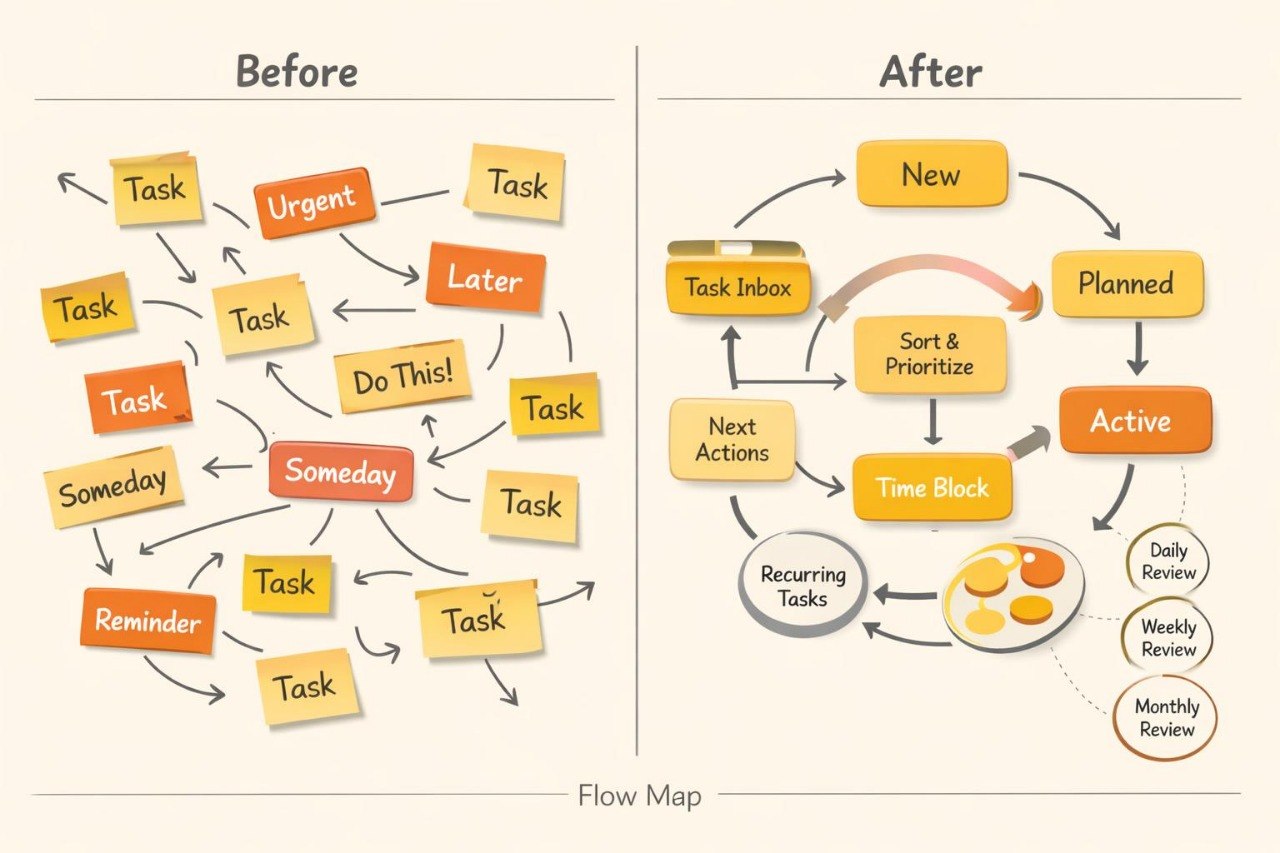
Struggling to manage tasks when they arrive from several areas and change throughout the week? You are not alone: new responsibilities are often added to an already full schedule without reviewing workload or priority. Some tasks remain in separate notes, others appear more than once, and important stages become lost among everyday responsibilities. Even a detailed multi-week map may become difficult to use when there are no defined rules for adding, moving, and completing tasks. Flow Map helps create a consistent route for each item and maintain order across the whole planning system.
2. Solution
This course will teach you how to manage the full working cycle of a task. You will explore how to collect new items in one place, review their relevance, and define the next specific action. The materials explain how to move tasks between stages without duplication or loss of important details. Practical activities guide you through preparing daily, weekly, and multi-week review rules. In the final module, you will create a personal Flow Map connecting active tasks, future plans, recurring responsibilities, and completed stages.
3. What’s Inside
Module 1: Task Intake Point
Create one place for recording new tasks, ideas, reminders, and future responsibilities.
Module 2: Sorting the Flow
Organize entries by category, timing, workstream, and required level of attention.
Module 3: Defining the Next Action
Turn broad or unclear task descriptions into specific actions that can be placed within a schedule.
Module 4: Flow Stages
Create separate stages for new, planned, active, paused, and completed tasks.
Module 5: Priority Routing
Determine working order according to relevance, timing, dependencies, and current workload.
Module 6: Time Block Placement
Move selected actions from the task map into suitable daily and weekly time blocks.
Module 7: Managing Delays
Work with postponed items, external delays, and tasks that do not yet have a defined date.
Module 8: Recurring Flow
Prepare a structure for regular reviews, preparation activities, household responsibilities, and recurring work processes.
Module 9: Review Cycles
Create a brief daily review, a detailed weekly check, and a broader multi-week overview.
Module 10: Your Complete Flow Map
Combine every stage into one connected map showing how tasks move through the planning system.
4. Who Is This For?
✅ Suitable if you:
- receive tasks from several areas;
- maintain separate lists and notes;
- regularly reschedule unfinished activities;
- manage several parallel plans;
- want to view the current stage of each task;
- are prepared to review your system regularly.
❌ May not suit you if you:
- need only a basic daily schedule;
- work with a small number of simple activities;
- do not intend to conduct regular reviews;
- require personal management of your schedule.
5. What You’ll Learn
- create one intake point for new entries;
- distribute tasks across at least five working stages;
- define a specific next action;
- assess priorities using several criteria;
- move selected tasks into time blocks;
- create guidelines for postponed responsibilities;
- prepare three levels of recurring review;
- organize recurring activities;
- build one complete personal Flow Map.
6. Refund Terms
A refund request for Flow Map may be submitted within 30 calendar days of the order date. Each request is reviewed according to the store’s published terms, the relevant order information, and the amount of material already completed. Learners should review the module content and current refund conditions before placing an order.
7. Certificate
After completing every module and preparing the final Flow Map, the learner may receive a digital Daylume certificate. The document includes the plan name and confirms completion of the corresponding learning materials.
1. How does the learning process work?
1. How does the learning process work?
Each plan contains structured modules, written explanations, practical activities, and materials for independent study. Learners can work at their own pace and return to earlier sections while applying the methods.
2. How are the Daylume plans different?
2. How are the Daylume plans different?
The plans are arranged in ascending order according to the amount and depth of the included materials. Higher plans may contain additional modules, detailed exercises, planning templates, practical examples, and broader materials for developing personal productivity systems.
3. Is previous experience required?
3. Is previous experience required?
Previous experience is not required for the introductory plans. The materials begin with foundational time-planning principles, while more detailed topics are introduced gradually through everyday situations.
4. Is a certificate provided?
4. Is a certificate provided?
After completing the required modules and final activity, a learner may receive a digital Daylume certificate. It confirms that the learning materials included in the selected plan have been completed.
Share