Daylume
Cloud Sphere
Cloud Sphere
Couldn't load pickup availability
Self-paced learning overview
- 📥 Digital file available after purchase
- ♾️ Long-term availability
- 🔒 Secure checkout
- 🗓️ Content updated in 2026
1. Problem Statement
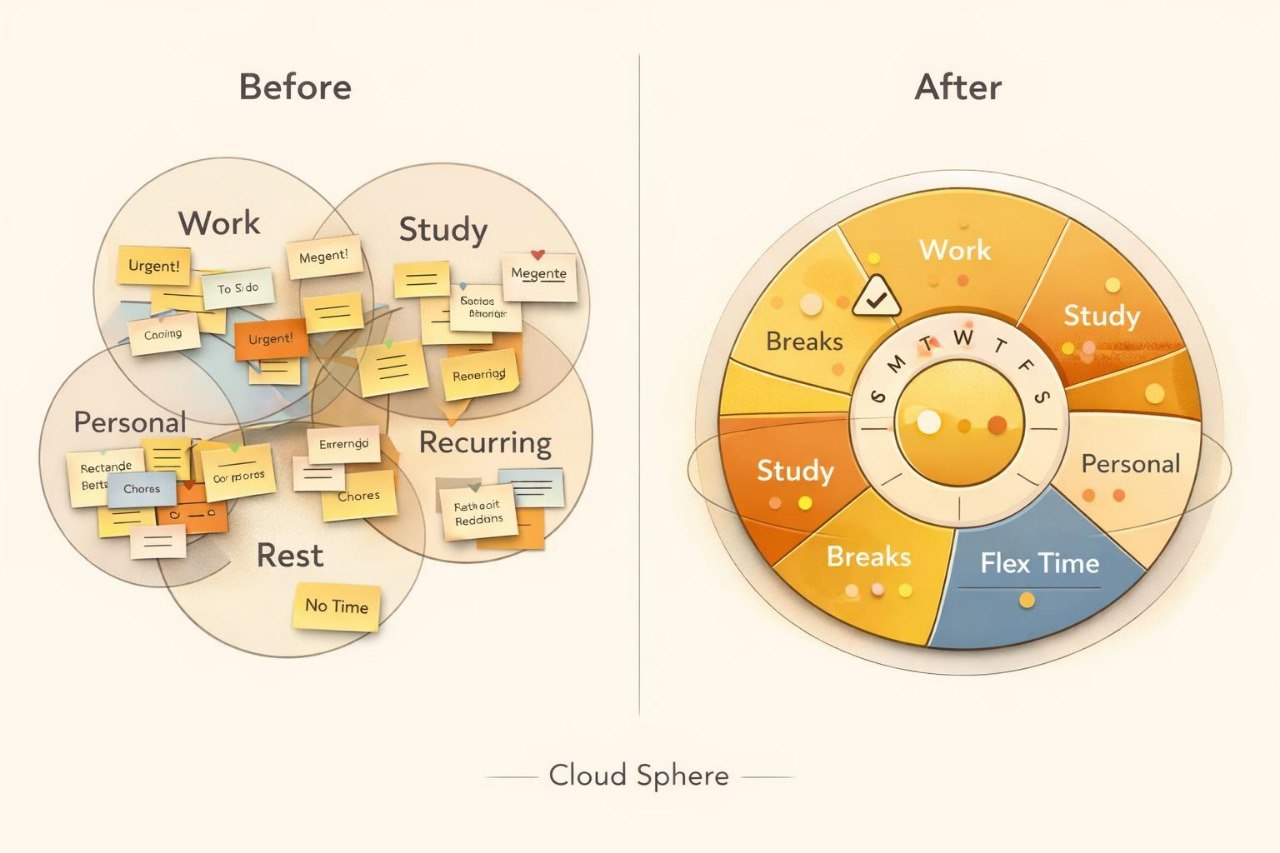
Struggling to combine work assignments, personal plans, and everyday responsibilities within one schedule? You are not alone: separate lists may appear organized while creating an overloaded week when viewed together. When every area is planned independently, several demanding tasks can unintentionally be placed on the same day. Rest may then be postponed, minor responsibilities may accumulate, and priorities may begin competing for the same time. Cloud Sphere helps learners view the main areas of their week as one connected structure and identify where time may need to be redistributed.
2. Solution
This course will teach you how to prepare a complete weekly map that considers several areas of daily life. You will explore how to organize tasks by category, attention level, duration, and frequency. The materials explain how to review the workload of an entire weekly cycle rather than looking only at individual days. Practical activities guide you through creating thematic blocks, flexible spaces, and recovery periods. By the end of the course, you will prepare a personal planning sphere in which your main areas are connected within one structured view.
3. What’s Inside
Module 1: Mapping Your Life Areas
Identify the main areas that regularly use your time, including work, study, household responsibilities, rest, communication, and personal tasks.
Module 2: Attention and Energy Patterns
Observe which parts of the day are more suitable for analytical, organizational, creative, or recurring activities.
Module 3: Building Weekly Spheres
Group related tasks into thematic areas and place them across the week without concentrating too much work on one day.
Module 4: Recurring Responsibilities
Create a separate structure for activities that repeat daily, weekly, or monthly.
Module 5: Space for Recovery
Review the role of breaks, unscheduled periods, and task-free time in maintaining a steady working rhythm.
Module 6: Conflict and Overlap Review
Identify scheduling conflicts, clusters of demanding work, and duplicated tasks appearing across separate lists.
Module 7: Adaptive Weekly Planning
Learn how to revise a schedule after an event changes or a new responsibility appears without rebuilding the entire week.
Module 8: Your Cloud Sphere Map
Prepare a complete weekly map containing task areas, time blocks, recurring responsibilities, and flexible periods.
4. Who Is This For?
✅ Suitable if you:
- maintain several separate task lists;
- combine work, study, and personal responsibilities;
- regularly place too many tasks on individual days;
- want to view the whole week as one connected system;
- would like to include breaks and recovery periods in planning.
❌ May not suit you if you:
- need only a basic one-day template;
- do not want to review different areas of your schedule;
- require an individually prepared plan;
- prefer a rigid system with no room for adjustments.
5. What You’ll Learn
- identify at least five main areas within your week;
- create separate categories for recurring responsibilities;
- place demanding tasks according to attention patterns;
- identify at least three scheduling conflicts;
- include flexible blocks within each weekly cycle;
- reserve suitable periods for breaks and recovery;
- prepare a seven-day workload map;
- create one complete Cloud Sphere Map.
6. Refund Terms
A refund request for Cloud Sphere may be submitted within 30 calendar days of the order date. Each request is reviewed according to the store’s published terms, the relevant order information, and the amount of material already completed. Learners should review the course description, module list, and current refund conditions before placing an order.
7. Certificate
After completing all modules and preparing the final Cloud Sphere Map, the learner may receive a digital Daylume certificate. The document includes the plan name and confirms completion of the included learning materials.
1. How does the learning process work?
1. How does the learning process work?
Each plan contains structured modules, written explanations, practical activities, and materials for independent study. Learners can work at their own pace and return to earlier sections while applying the methods.
2. How are the Daylume plans different?
2. How are the Daylume plans different?
The plans are arranged in ascending order according to the amount and depth of the included materials. Higher plans may contain additional modules, detailed exercises, planning templates, practical examples, and broader materials for developing personal productivity systems.
3. Is previous experience required?
3. Is previous experience required?
Previous experience is not required for the introductory plans. The materials begin with foundational time-planning principles, while more detailed topics are introduced gradually through everyday situations.
4. Is a certificate provided?
4. Is a certificate provided?
After completing the required modules and final activity, a learner may receive a digital Daylume certificate. It confirms that the learning materials included in the selected plan have been completed.
Share